




Straddle Strategy for Binary Options
By using the Straddle strategy for binary options, you can profit from movements in the price of an underlying asset without having to predict the exact direction of the market. What matters most is market volatility — the greater the price movement, the higher the potential profit from the trade.
This article provides a detailed explanation of how the Straddle strategy works for binary options. The strategy focuses on trading volatility and does not require additional technical indicators, but it involves increased risks.
In This Lesson, You Will Learn:
How Does the Straddle Strategy Work?
Types of Straddles
Key Features of Binary Options Trading Using the Straddle Strategy
Volatility and Time
How to Trade Binary Options Using the Straddle Strategy
How Does the Straddle Strategy Work?
The Straddle strategy involves opening multiple trades simultaneously, with positions taken in opposite market directions. A trader purchases both CALL and PUT options with the same strike price and expiration date. The exercise price must be identical for both contracts.
There are two types of straddles: long straddles and short straddles. The latter is not applicable to the binary options market, so today we will focus on the former.
Types of Straddles
Long Straddle – involves purchasing both CALL and PUT options with identical strike prices and expiration times. This method is popular among traders who expect significant price movements but are uncertain about which direction the market will take.
Experienced traders often use long straddles ahead of earnings reports and other major news events that could affect an asset's price. The news may be positive or negative, but market volatility is likely to increase in either case.
Short Straddle – involves selling both CALL and PUT options with the same expiration dates and strike prices. This approach allows traders to profit in markets with low or zero volatility. Profit depends entirely on fluctuations in the asset's price. If prices rise or fall significantly, the position will result in a loss.
In the binary options market, only CALL and PUT options are available for purchase, so we will consider only the short straddle.
Key Features of Binary Options Trading Using the Straddle Strategy
When using the long straddle strategy, a trader expects a substantial upward or downward movement in the underlying stock's price before expiration. This approach is specifically designed for highly volatile market conditions, where prices fluctuate significantly.
The trader's goal is to purchase two options simultaneously—a PUT and a CALL—with identical strike prices and expiration dates. The strategy can be applied to any underlying asset, provided it is sufficiently volatile.
Let's look at an example. A trader simultaneously purchases:
An in-the-money CALL option with a strike price of $40;
An in-the-money PUT option with a strike price of $40.
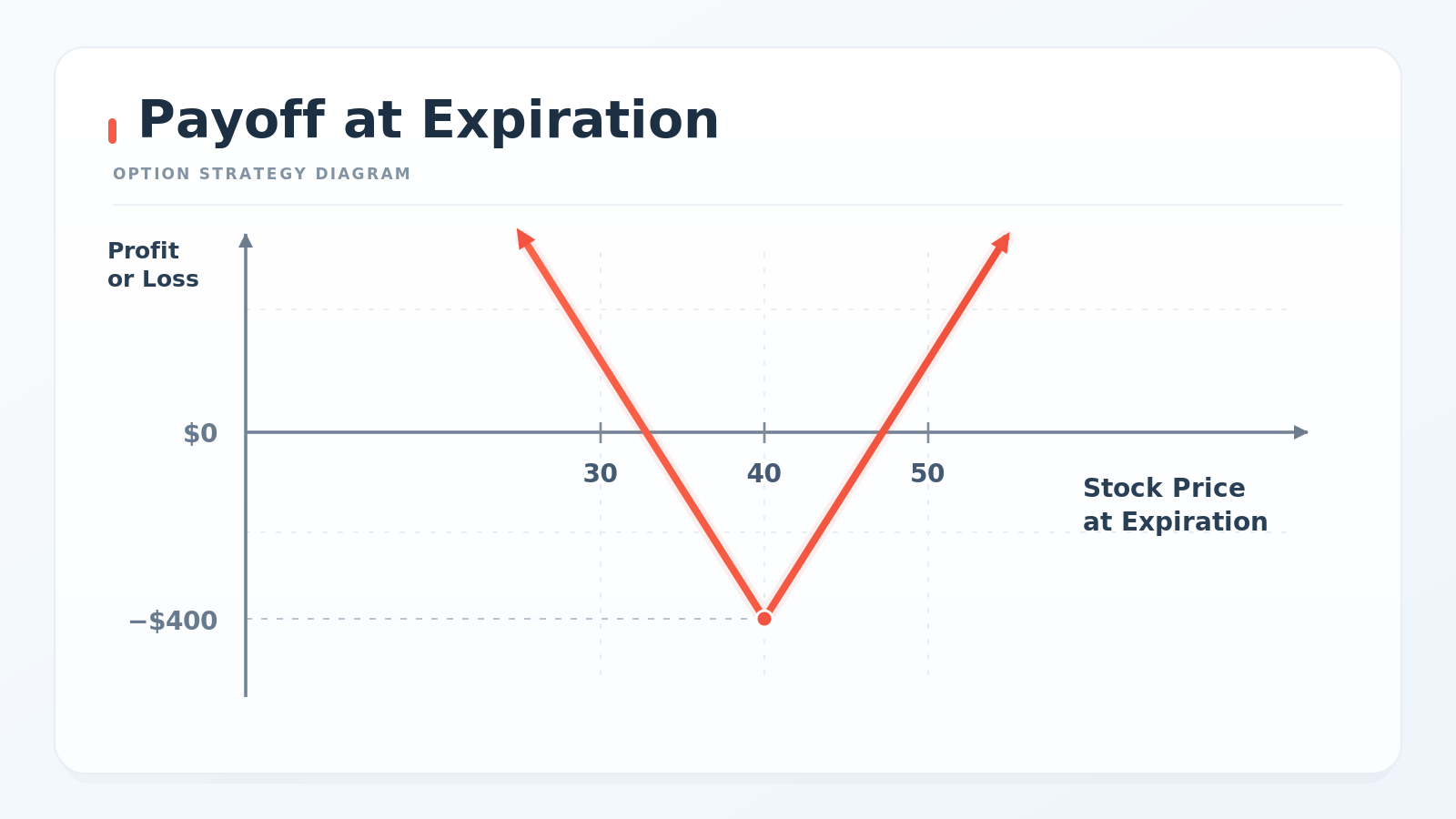
Profit (or Loss) / Strike Price
A trader can adjust the strike prices upward or downward, but most strategies focus on in-the-money options, also known as ITM options. The direction of the price movement does not matter—the important thing is that the market does not remain stagnant.
The breakeven points are located above and below the strike price because both CALL and PUT options are purchased simultaneously. The lower breakeven point is $34, calculated by subtracting the combined premiums from the strike price. The upper breakeven point is $46, calculated by adding both premiums to the strike price.
Therefore, the trader breaks even if the asset's price reaches either $46 or $34. If the price at expiration is above $34 but below $46, the combined position will result in a loss.
In theory, your maximum potential profit is unlimited. For example, a Pocket Option user managed to earn $3,379 using this strategy. The trader successfully executed several trades when the underlying asset—in this case, the Turkish lira—experienced a sharp decline in value, generating a substantial profit.
The further the asset's price moves away from the strike price, the greater your potential earnings.
Volatility and Time
When using a long straddle, a trader expects a significant price movement in either direction. Therefore, expectations of high market volatility are a strong reason to consider this strategy.
If the underlying asset's price remains unchanged, a rapid increase in volatility can raise the value of both options, allowing the trader to make a profit even before the options expire.
This is a short-term strategy. Options with limited expiration periods need to experience significant price movements quickly; otherwise, they are highly likely to result in losses.
Since a straddle involves purchasing two long option positions, every day without meaningful price movement in the underlying asset reduces their value.
How to Trade Binary Options Using the Straddle Strategy
Suppose an asset is trading at $40. We decide to purchase one CALL option with a strike price of $40 for $200 and one PUT option with the same strike price of $40 for another $200.
As a result, the total cost of both trades is $400. The maximum potential loss is also $400. This loss may occur if the asset's price remains at $40 when the options expire.
The strategy may seem simple, but it is not. A long straddle should be used when volatility is still relatively low but beginning to increase—not when volatility is already high.
Additionally, if implied volatility rises rapidly without a corresponding movement in the underlying asset's price, the trader should consider closing the position early.
Caution: The Straddle strategy can only be applied if your chosen binary options trading platform supports pending orders. This feature allows you to execute trades automatically as soon as the price reaches your target levels.
Key Takeaways
Breakeven Point – the asset price at which the profit from a trade equals the total costs associated with that trade.
Implied Volatility – a measure of the market's expectations regarding the magnitude of future price fluctuations in an underlying asset.