




Strangle Strategy for Binary Options
The Strangle strategy is based on expectations of changes in market volatility. A trader purchases CALL and PUT options with the same expiration date but different strike prices. The key is for the asset's price to move as significantly as possible in either direction.
This article provides a detailed explanation of how to use the Strangle strategy with binary options. The strategy does not require additional technical indicators and can help experienced traders generate substantial profits. However, you should only use it after practicing on a demo account.
In This Article, You Will Learn:
How Does Volatility Trading Work?
What Is the Strangle Strategy?
How to Trade Binary Options Using the Strangle Strategy
How Does Volatility Trading Work?
No one can guarantee which direction market prices will move. However, there are times when it is clear that the market is volatile (subject to significant fluctuations). Some assets are less affected by volatility, while others experience much greater price swings. High volatility is generally considered a deviation of at least 10% from the average price, while low volatility involves fluctuations of only a few percent.
Binary options allow traders to potentially earn substantial profits in unstable markets. Moreover, the direction in which prices move does not necessarily matter. This trading approach is known as volatility trading. It does not require traders to predict the direction of price movements—they only need to make sure that prices are changing rapidly enough.
What Is the Strangle Strategy?
There are two common strategies for trading volatility: the Strangle and the Straddle. In this article, we will focus on the former.
The ultimate goal of this trading approach is to generate profits regardless of the price trend of the underlying asset. A trader purchases CALL and PUT options with the same expiration date but different strike prices. Strangles are divided into two types: long strangles and short strangles.
A Long Strangle involves purchasing CALL and PUT options on the same underlying asset with identical expiration dates. If the price moves sharply in either direction, the trader can make a profit. This is because, when purchasing a CALL or PUT option, the potential loss is limited, while the potential profit is theoretically unlimited. As a result, the profit from the option that expires in the money can more than compensate for the loss from the option that expires out of the money. This approach is suitable only when you expect a sharp change in the asset's anticipated volatility.
The Short Strangle strategy involves selling out-of-the-money CALL and PUT options. It is not used for binary options trading, so we will not discuss it further in this article.
How to Trade Binary Options Using the Strangle Strategy
Let's explore how the long strangle strategy can be applied to different types of binary options.
Trading 5-Minute / 30-Minute / 60-Minute Options
As mentioned earlier, the Strangle strategy requires purchasing out-of-the-money CALL and PUT options. Most binary options brokers allow traders to open two opposing positions simultaneously.
To start trading with this strategy, draw a price channel by connecting at least three support or resistance points on charts with timeframes shorter than, equal to, and longer than the option's expiration period.
For example, if an option expires in 30 minutes, use 15-minute, 30-minute, and 60-minute charts to construct the channel. Analyzing price movements on a longer timeframe helps identify the overall trend. Similarly, a shorter timeframe allows you to determine an appropriate entry price. Remember that the channel must be constructed by connecting at least three support or resistance price points.
Step-by-step instructions:
Start by analyzing the trend on a longer timeframe. If the price forms progressively lower highs within the channel, the trend is bearish, and vice versa.
When prices form lower highs, purchase a PUT option as the price touches the upper boundary of the channel.
When the price reaches the lower boundary of the channel, purchase a CALL option with the same expiration time. The payout will be lower due to the remaining time until expiration, but you can still make a profit if the price moves toward the target level.
Possible expiration scenarios when trading with the Strangle strategy:
Prices rise: The PUT option results in a loss, while the CALL option generates a profit. Suppose an option that expires in the money provides a 75% payout. The net loss would be 12.5% of the total invested capital. If a trader invested $200 across both options, the payout at expiration would be $175.
Prices fall: The net loss would amount to 12.5% of the invested capital.
Prices remain within the channel: Both contracts generate profits. The net return would be 75% of the total invested capital. By investing $200 in both contracts, the trader would receive $350 at expiration.
An example of trading the USD/JPY currency pair using the Strangle strategy:
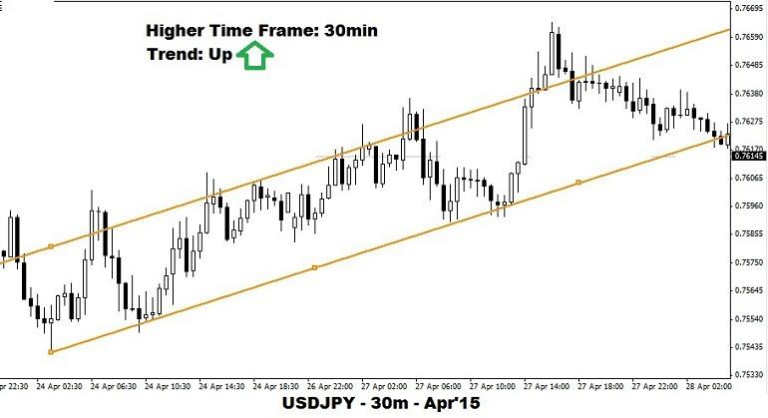
30-minute timeframe showing an upward-trending price channel
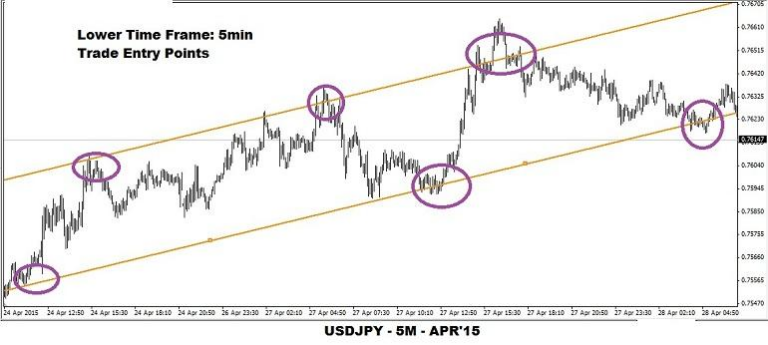
5-minute timeframe showing a price channel with marked entry points
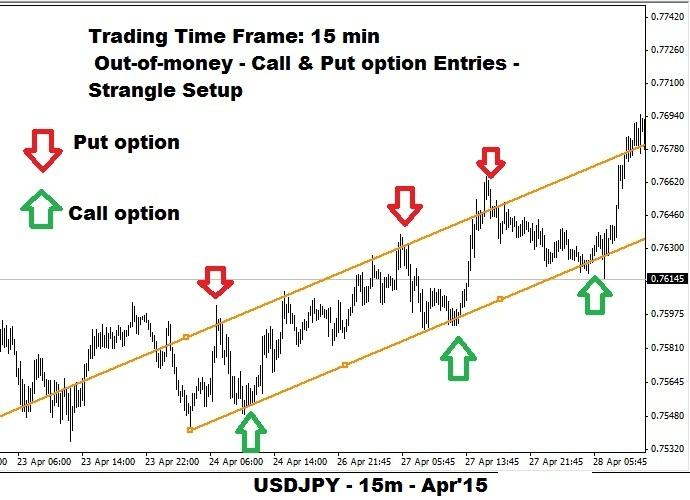
15-minute timeframe showing entry points for out-of-the-money CALL and PUT options
The Strangle strategy for binary options will generate a profit only if volatility does not change dramatically.
Trading One Touch Options
The Strangle strategy can also be applied to One Touch binary options trading. The main challenge is that the asset's price must touch or break through a target level specified by the trading platform.
When the price approaches the lower boundary of the channel, analyze the target price of the One Touch CALL option offered by your broker. If this target is close to the upper boundary of the channel, open a trade. Similar rules apply when purchasing an out-of-the-money PUT option.
One Touch contracts are best suited for range-bound markets where prices experience sharp movements near the upper and lower boundaries of the channel.
Possible trading scenarios:
The price touches the One Touch CALL target: The One Touch option contract becomes worthless. The net loss amounts to approximately 12.5% of the total invested capital.
The price touches the One Touch PUT target: The outcome is the same as in the previous scenario.
The price touches both targets: The trader earns more than 75% of the total invested amount.
The price remains within the channel: Since neither target is reached, the trader loses the invested amount.
A Double One Touch option has a structure similar to the Strangle strategy. The trader wins if the price reaches either of two target levels—one above and one below the current market price.
The long strangle strategy is suitable only for experienced traders who can analyze charts quickly. However, the risks can be worthwhile. For example, a US trader named MichaelB managed to earn $1,500 in net profit from a single trade on Pocket Option using this approach.
Beginners should avoid using this strategy without first practicing in a trading simulator.
Key Takeaways
Volatility – the degree to which the price of an asset rises or falls over a given period.
Option Spread – a combination of options of the same type on the same underlying asset, but with different strike prices and/or expiration dates, where some positions are long and others are short.
Strangle – an options strategy involving the simultaneous purchase or sale of PUT and CALL options with different strike prices.
Strike Price – the fixed price specified in an option contract at which the option holder has the right to buy or sell the underlying asset upon expiration.
In-the-Money (ITM) Option – a CALL option with a strike price below the current market price of the underlying asset, or a PUT option with a strike price above it.
Out-of-the-Money (OTM) Option – a CALL option with a strike price above the current market price of the underlying asset, or a PUT option with a strike price below it.
Price Channel – a defined trading range within which an asset's price fluctuates.